
While tattoo ink is still an awkward stranger to my own skin, body art and alteration isn’t. The older years have seen a much slower modification process and retiring or reversing of many, and while that’s just a part of my aesthetic now, that doesn’t mean I’m done wanting more. Scarification is probably my favourite process to undergo, albeit a bit misunderstood. But… wait, doesn’t it hurt? Won’t it get infected? After all, you’re intentionally opening up the first few layers of skin and exposing your interior to the exterior all around you, there’s always a possibility of complication even in the best environments. It could tug and pull during healing, creating lots of discomfort and delayed healing. There can be a ton of nerve damage that needs time to slowly repair. Scar tissue can blow out beyond the intended lines and distort or create an undesired effect. But that’s just part of why I think it’s so amazing, and the body really is an extraordinary thing.

My first scarification experience was back in ’06. I was sixteen, a few months shy of my next birthday. At this point I was already heavily pierced, which of course I had mostly done myself. I was looking for a new “capable” piercer, since my first and only professional experience of getting two crossing industrials didn’t go great at all (I was also fifteen then and never even asked for ID). A tattoo artist in my city got more talk than others, so I figured the piercer had to be good as well. And as a young, naive girl just discovering heavier modification work, it was exciting to find someone who knew what I was talking about and who was interested in it, and wanted to work on others.
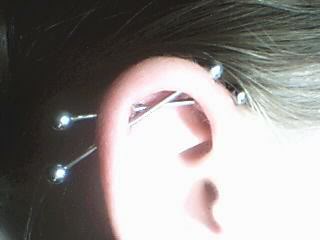
Now, it’s easy to look back and cringe harder than a crushed pop can, but while my early professional experiences were much less than that, even downright sketchy, it was my entry into the heavy modification world, and I still have stuff I love from then. Those experiences—however sketchy—began an incredible journey that not only opened my mind to the idea of taking control of my own body and shaping it how I want, but it changes me as a person over and over again, each time a step closer to who I want and hope to be. You learn a lot about yourself and the public in general when you get into body modification, especially in regard to the people you’re around the most. You become quite self-aware. My pain endurance & tolerance levels are pretty well-oiled, which has helped me in many situations, not just regarding the physical discomfort ones. I feel like it has affected me as a whole, my emotions, my thought processes, my appearance (of course) and how to navigate tricky situations because of it. It’s made me a better person, even if I am reclusive and uneasy and fragile and people just don’t get me.
Cutting human skin with intention naturally does not have the best connotations associated with it, and the pain that goes along with the process is often misconceived and presumed to be desired because of some deep, unhealthy mental state. And it’s safe to say I’ve had these assumptions made of me by many different people, from online harassment from strangers after photos of mine got around, to families and friends in the real world. When I was younger, I never saw any of the negatives in scarification. It was never mutilation or self-harm, it was beautiful and fascinating. The body would create it’s own unique skin decoration without needing to introduce any other ingredient like ink or a piece of jewellery. Just mark it with something sharp, and it’ll do its thing. That’s really what drew me in at first—the simplicity of it and how natural it ended up looking fully healed. Now, every skin is different, and everyone heals their own way. Paler British complexions like mine usually end up with subtle scars, white with a hint of pink or light brown, and often settle back down if they did raise a little as they get older. Darker skin tones tend to retain colour and can become quite dark. They also generate more pronounced and blown-out scarring.
Back when I first got cut, raised scars were all the rage, and everyone seemed afraid that their work wouldn’t end up being noticeable enough. So you had to prevent the cut from scabbing as much as possible, by always keeping it wrapped, scrubbing it with a mix of salt or sugar and vaseline, scrubbing it with a toothbrush (with or without the addition of hydrogen peroxide), and even picking at scabbing was recommended by some people. This was basically the aftercare for my first scarification, and as a dumb teen, it could’ve gone in any direction.


The first shower is by far the worst experience of it all, and because my chest was done in multiple steps (not really sure why, probably because he had never done it before), I got to experience my first design multiple times. I was never the most comfortable or confident about the whole situation at any point, an older person would have picked up on that and probably listened to their instincts a bit better. But I wanted to be the 16 year old with a scar piece, something nobody else had. How cool, right?! Not only did it teach me a lesson about professionalism, but it later made me realize that not everyone shared my same views about all this, and how much tension modification might create for me socially if I continued and became much more physically altered.
He didn’t like using the scalpel handle, which was also kinda odd to me. The design ended up way off. I don’t even remember confirming the final two circles and it’s quite possible the stencil was put on in a lying position. I also remember being blamed for the mistake when I pointed it out, unfortunately it was already done. Some people have said that they kinda like it, like it represents how we aren’t perfectly symmetrical, or a female reference about how boobs aren’t the exact same (as the piece has acquired many light-hearted boob remarks). And even though it isn’t perfect, neither is everyone’s first tattoo often times than enough. I still actually like it a lot. It could’ve ended up looking a lot worse for someone doing it for their very first time, and being a scar, it doesn’t stand out as sorely as a bad chest tattoo.
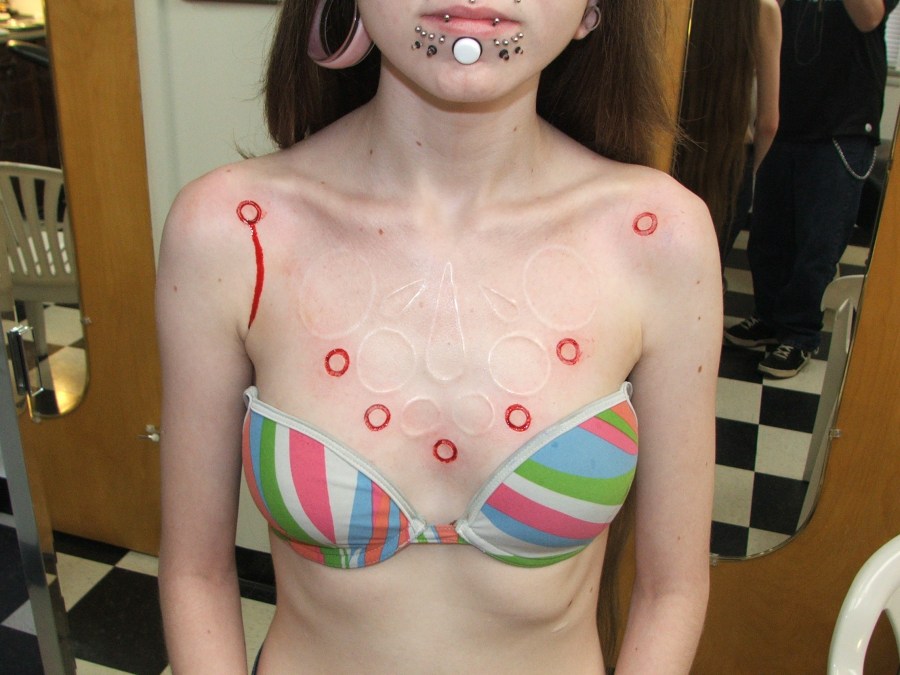
My chest had the smallest outermost circles added in by another artist while attending Skindependence, a modification-enthusiast meetup that became a thing through the Bodymod.org website and forum community (which no longer exists). He also started my slug leg sleeve a few days after the circles were done.
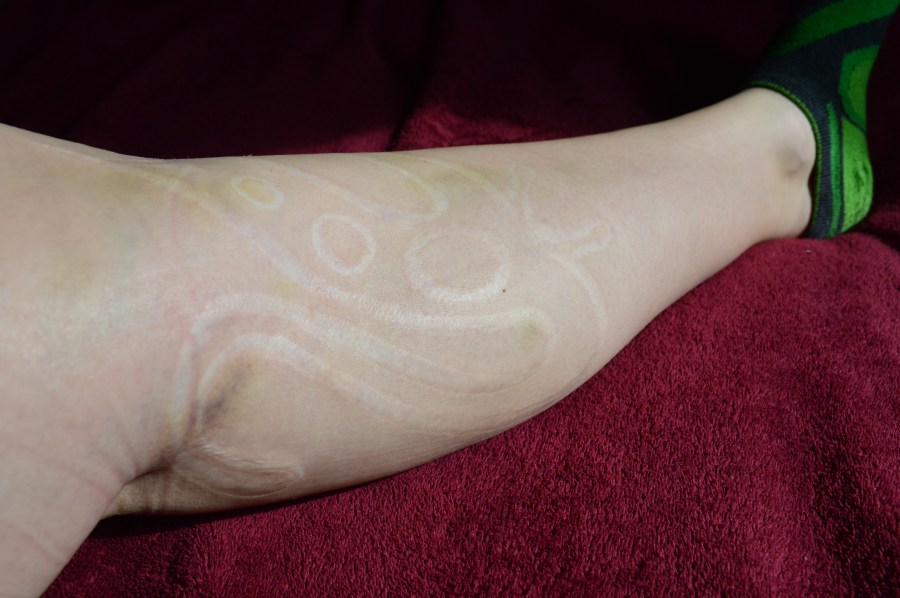
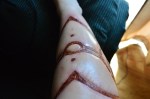
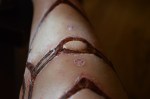
The leg was a lot more painful than the chest, and the linework a lot deeper and wider. Healing seemed a little slow and there were a couple swollen days, but no major inconveniences. Parts did tug a bit during healing, and the piece remained quite dark for some time, beginning in the purples, and blew out more during initial maturation, eventually settling out to the image above. Still hoping to add a few more slugs one day.

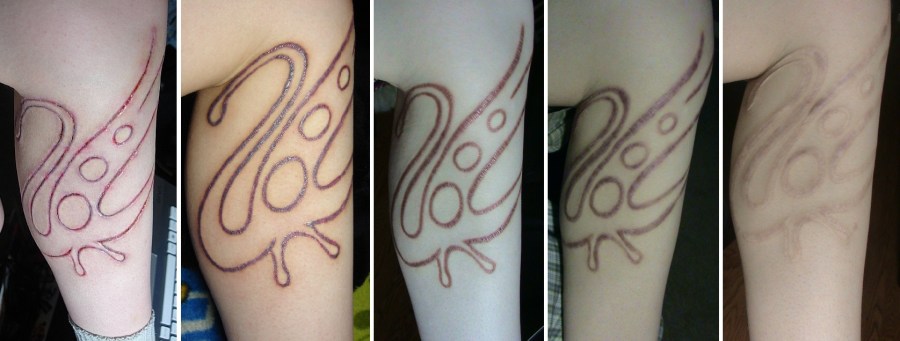
Most of the scrubbing aftercare was something I ignored with both pieces. I was happy to spare myself the discomfort and see what my body did by itself. Picking at them was a joy, however, but I only removed what was ready. This piece did end up distorting and widening more than my chest and any of my other pieces, but it turned out looking pretty great in my opinion.
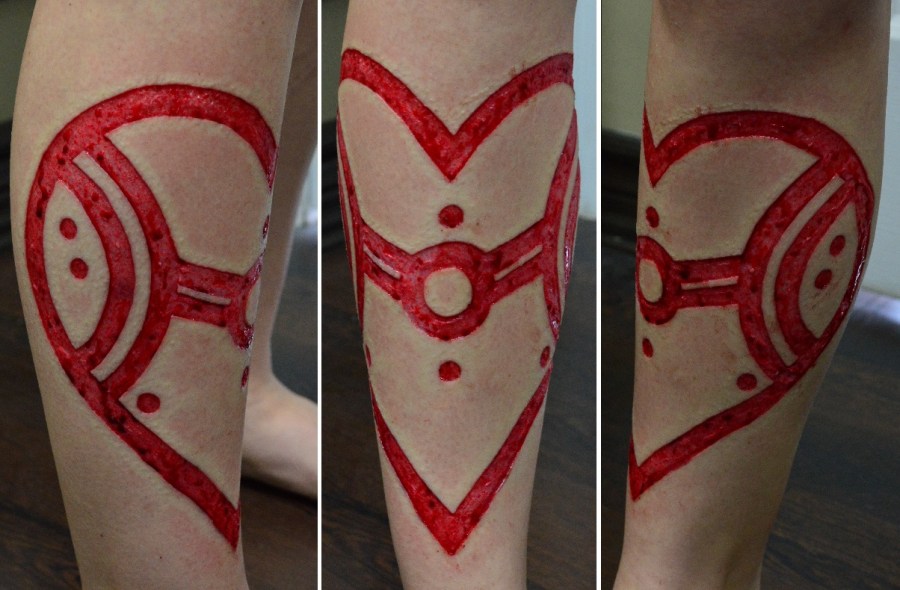
The third piece done professionally is my most recent addition, and probably the most meaningful. The glider heart is designed from a unique tattoo of a man that basically created the modern modification community, by developing an online platform everyone could access together and share their experiences, photos and stories. My heart was based off of other glider heart concepts but I personally designed it to my liking, using photos of Shannon to get it looking just right. Mine was so large it could be more complex than what was out there so far, and it turned out looking just perfect.

Web communities like BMEzine and Bodymod.org played huge roles in my younger years, even if I only got a chance to hang out for a little bit while it was still good. Facebook has really ruined the idea of having a safe space for modified people to share and speak freely without so much discrimination or hate, or even any kind of harassment (though I feel like the tone would be different these days regardless of that kind of safe space). The people there participating were there because of a shared interest, and it worked a lot better. The memory of it all obviously means a lot to me, and the understood visual of the piece also shadows a few personal meanings.
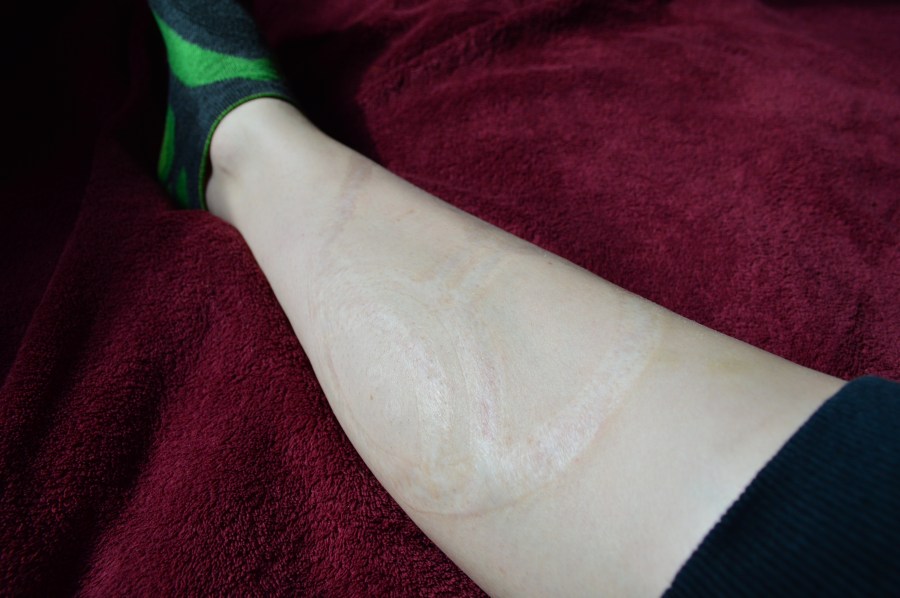

My leg looked so meaty and exposed. Physically, it debilitated me at home and hampered my ability to work comfortably in an already uncomfortable job setting. The hardships that went along with the healing process were so fitting for this piece and made it mean that much more to me. It gave me just a little more insight. The details and the more personal bits were discussed and documented thoroughly on my Facebook page before this site existed, so feel free to seek me out and take a look at the public photo album dedicated to it for yourself. There have been considerations for specific artists to expand on this piece with ornate and geometric additions.
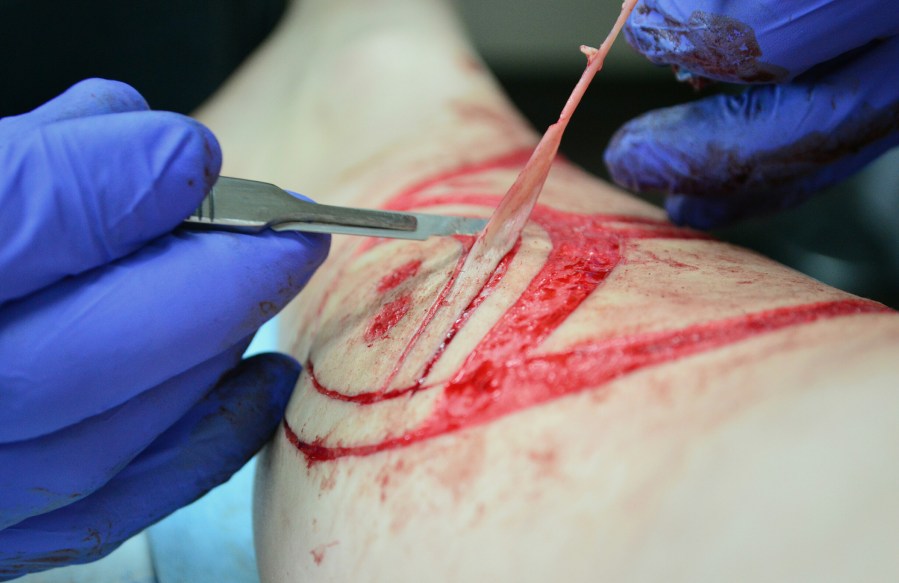
Scarification has existed longer than tattooing within tribal communities, dating back thousands of years. It was used to communicate with others, openly displaying social ties and cultures. It marks rites of passage in a person’s life and can be part of ritual and spiritualistic experiences. For myself, it began as an aesthetic thing, but like most other modifications, it was later about the experience and that’s what kept me getting more and trying more on my own body. Which leads to what are probably my most controversial scarifications.
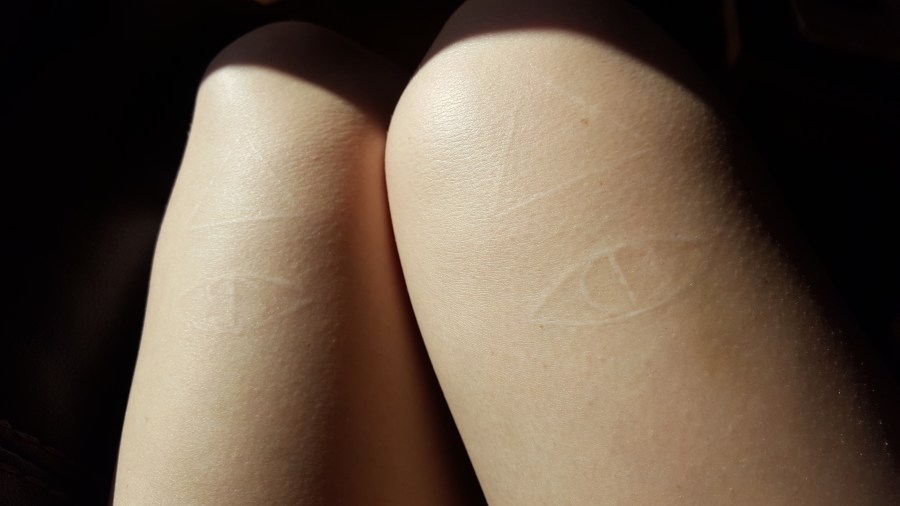


It began with a triangle above my right knee, done soon after my chest but before my slug. I just wanted to see if I could cut myself, and it was successful enough that it gets noticed by others until this day even if it isn’t well done. Scalpel blades were acquired from the piecer who did my chest piece, who gave them to me because the conch punches he did were growing an excessive amount of granulated tissue (we both had no idea what it was then), he said it needed to be removed but didn’t want to do it himself, said I would do it better (I was seventeen, didn’t end up attempting the removal and they got better with time). Later, I added a symbol underneath and mirrored both objects onto my left leg for symmetry. The symbol was a random doodle made during a conversation with a then-boyfriend I met through BME (the online community associated with the glider heart above), who said he wanted to have matching scars. One day I went online and he randomly sent me a photo of his work, and naturally I felt obligated to put it into my skin. Now I’m just glad its not that conspicuous. The triangles are still cool, though.
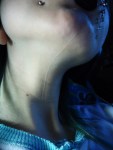
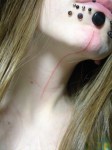
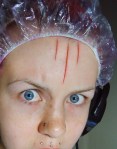
Later on (2009), I moved to my face, starting with a line in the middle of my chin that worked down my throat. A few years after that (2012), three lines appeared down the center of my forehead. There are hopes for a more intricate concept in the future when it seems like a better time to expand on such visible work. Unfortunately I don’t have the best photos of these, my face markings are very subtle and hard to photograph now, and I had bangs that covered my forehead when that part was new and didn’t go out of my way to take shots of either section as they healed. The chin and legs were redone a couple times, and if you look carefully you can see it in the healed result. The forehead lines were one of the last DIY procedures I did on myself. Working on my own body made me feel a way that has been hard to replace, and while I’ve never been a cutter or practiced self-harm (in my books), I feel like those experiences helped me feel better emotionally, like self-harm can for so many people struggling, and it may have helped me avoid it and grow stronger in my own way that seemed a lot healthier to me. There’s so much more that goes along with feeling a little pain than just worrying about the idea of being in pain. If you can get your head to work around that obstacle, you might learn a thing or two yourself.
If you made it this far, I hope you enjoyed the read. Feel free to address me about any curiosities that came up while reading, or if you have any questions.

 eatenplacenta.com
I’ve missed you!
LikeLike